Discovering Volvic’s funerary heritage.
Visiting a village cemetery is like immersing yourself in the history of the commune and the region.
Some graves tell a particular story, whether of a well-known or unknown person, a personal history that is often closely interwoven with the history of the commune. What’s more, behind each grave is the work of a craftsman, a particular know-how, and this is especially true in Volvic.
Originally, in Volvic as elsewhere, cemeteries were located in the village, around the three churches. The main cemetery was in front of the Saint Priest church, and was called the Peyley (the pillar).
For reasons of hygiene, the Volvic municipality decided to build a new cemetery at Le Véry. Relocation and layout work began in 1806, and the cemetery was opened in 1811.
In 1845, a system of concessions was introduced, which had the merit of launching the production of funerary monuments throughout France, and of course in Volvic. The Volvic School of Architecture had been founded in 1820 by Comte de Chabrol, Prefect of the Seine, whose father-in-law, Charles Lebrun, Duc de Plaisance, was buried at Père Lachaise in a Volvic stone tomb carved in Volvic.
The establishment of the new cemetery coincided with the rise to prominence of a whole generation of newly-trained practitioners, most of whose worksites were opposite the cemetery.
The family vault was an opportunity for the contractors to show off their skills, especially as the Volvicois preferred their final resting place to their home. The Volvic cemetery can therefore be considered an open-air catalog, and even, as Yves Connier has written, “a form of conservatory for 19th-century funerary art in the Lower Auvergne”.
The Volvic communal cemetery is divided into 4 sections, covering an area of 1,231 m².
It comprises :
– an old cemetery (1st cemetery) with 591 graves and mass graves, resembling a labyrinth
– a 1st cemetery dating from 1942-43, with 149 graves and mass graves
– a 3rd cemetery dating from 1965, with 141 graves, a communal ossuary and a 6-place depository
– a 4th cemetery dating from 1977-78, with 452 burial plots, 2 columbariums with 12 spaces each, and a public cinerary area (Jardin du Souvenir).
Many of the monuments in the first cemetery are masterpieces of funerary architecture, built in Volvic stone of course, with the exception of one.
In the other cemeteries, you’ll find tombs of a more modern design, either in Volvic stone or granite, typical of the evolution of funerary monuments.
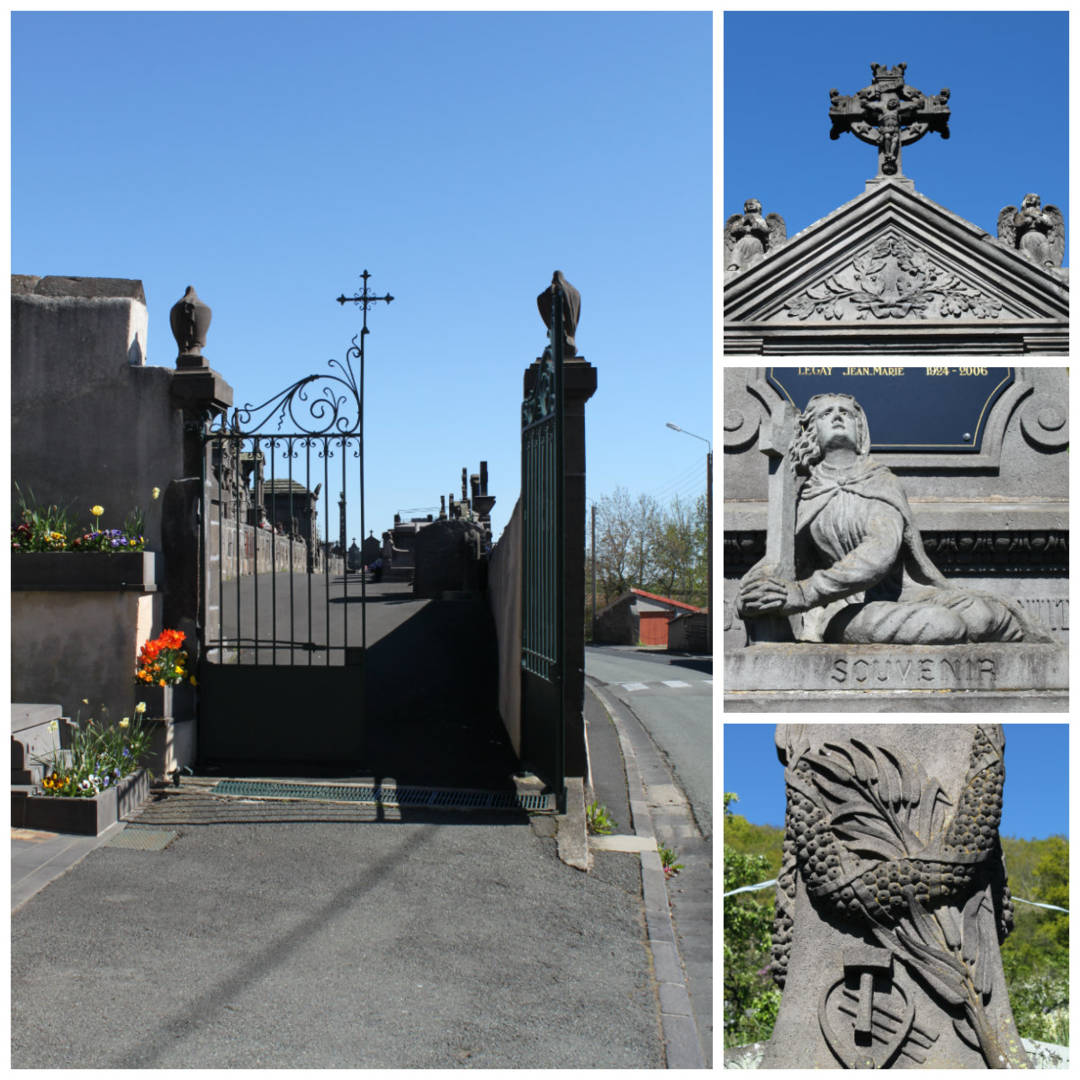
The visitor’s eye is drawn to the monumental look of the row of tombs on the left in the main alley. According to Volvic sculptor Fernand Auteroche, this alignment is probably due to an architect who studied the layout and layout of the concessions in order to assert the horizontal, the symbol of rest and death. The vertical steles, on the other hand, convey the idea of elevation to the heavens.
You’ll notice their strong religious connotations and the precision with which the decor is crafted. It’s fair to say that the people of Volvic took particular care with their final resting places. With the exception of the sculptor Pierre Boeuf’s house at no. 52 rue de la Libération, whose facade is worth a look, and a few middle-class houses, Volvic’s dwellings were largely unadorned and modest.
Some remarkable tombs :
The Legay-Chevalier vault (no. 43) : Legay-Chevalier was a former student and teacher at the Volvic School of Architecture, an entrepreneur and sculptor, inventor of the first patented saw and of the movable crane known as the cheval de bois, and was behind the construction of the Riom/Volvic railroad and the discovery of the Volvic water spring. It is one of the main characters in the Grotte de la Pierre scenography. The statue of a weeping woman was added after his wife’s death. The weeping woman theme can be found on several steles in different parts of the cemetery.
The Macheboeuf family vault (no. 47) : father a sculptor, son a doctor in Châtel-Guyon, grandson a member of the Institut Pasteur and the Académie de médecine. The latter gave his name to Place Macheboeuf, Grand’Rue. On a classical Greek-style base, the sculptor erected a pyramidal structure. The base features some of the sculptor’s tools : sledgehammer, thickness compass, chisels.
De La Vaissière vault (no. 56), former mayor of Volvic : neo-classical stele, set on a stone tablet, with the family coat of arms on the tympanum of the pediment.
Conchon de Rochevert vault (no. 57), owner of Château de Bosredon and former mayor : Neboux tomb in neo-classical style. The buffer consists of a three-step staircase leading to the tombstone. The balustrade consists of quatrefoils set in squares adorned with pearls around the perimeter and foliage in the corners.
At no. 99, one of the first enamelled lava stones : this huge column is adorned at the top with a Corinthian capital on which rests a funerary urn. Medallions on the shaft bear the names of deceased family members. On the supporting plinth is an enamelled lava signed by Gillet, an enameller and family friend of Volvic entrepreneur Legay-Chevalier, dated March 1877. It bears witness to the link between Volvic and the early days of enameling.
Chapelle Chanteloube (n°505) : neo-classical chapel with pyramidal roof. The top is crowned by a horizontal cornice decorated at its center with a water leaf. A magnificent wrought-iron gate closes the entrance.
Tomb no. 179 : the pediment is cut by two ogival arches resting on a cul-de-lampe decorated with foliage. A poppy flower occupies the central part. The acanthus capitals are of Corinthian influence. The letters are engraved on a square background, to catch the light.
Tomb of sculptor Pierre BOEUF (no. 135) : the only non-lava stele in the 1st cemetery, it bears witness to the artist’s originality. Made of soft limestone, it has unfortunately not stood the test of time. Originally, it was topped by a small owl. The fine engraving of the skeleton is gradually fading, as is the inscription “Sous cette terre Pierre Boeuf sculpteur mort le 28 févier 1881 à l’âge de 73 ans”.
Vault no. 184 : on this tomb, columns with Ionic baskets and crowns hanging from pegs are carved into the mass. The molded rampant cornices bear angels. The top is crowned with a quadrangular fleuron cross. A paschal lamb can be seen beneath the baldachin. The young Volvic resistance fighter Jean Lesme, known as Milamo, is buried here.
The doors of the tombs are called tampons. Their creation was often entrusted to apprentices as a test of their skills.
Text by Claire and Odette Agbessi, Volvic, Histoire et Patrimoine.

 No dogs allowed
 Updated on 17 March 2022 by Office de Tourisme Terra Volcana, les Pays de Volvic