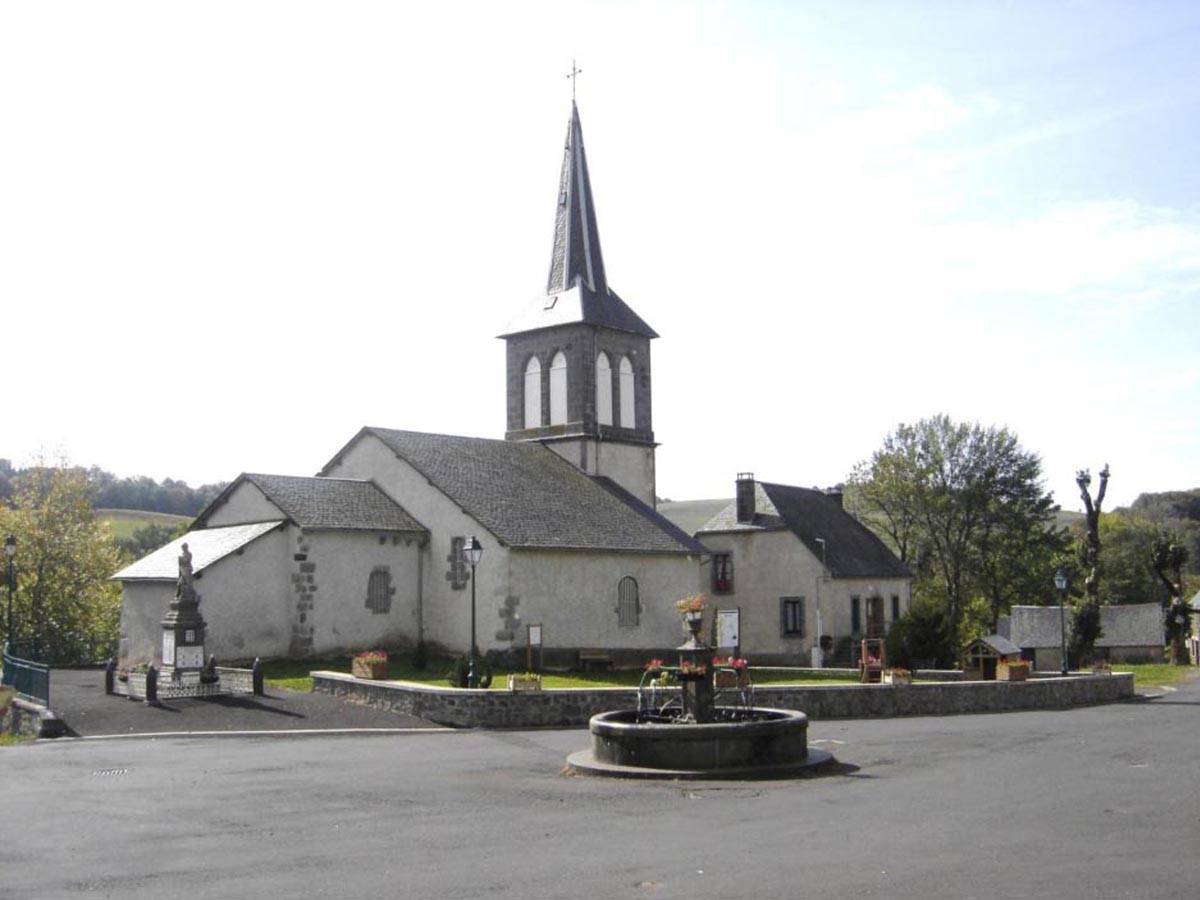
It overlooks the Gazoune river, which cascades down to Taillet (a locality of basalt rock).
Originally, there was a small chapel dating from 1157, of which the Romanesque choir, the three modillions on the outside of the church on the north side and the smaller buttress on the south(…)
It overlooks the Gazoune river, which cascades down to Taillet (a locality of basalt rock).
Originally, there was a small chapel dating from 1157, of which the Romanesque choir, the three modillions on the outside of the church on the north side and the smaller buttress on the south side remain. The construction of a church begins with the choir.
The edifice is built of andesite (a volcanic rock, probably extracted from Mont Dore).
The layout of this church is atypical, since the transept has been truncated due to lack of space ; it’s a false transept.
– Round-arched nave (barrel vault) ; 2 round-arched niches.
– Pillars with engaged columns (partially engaged in the walls).
– Historiated capitals (a specialty of Romanesque art), one of which near the entrance door is highly enigmatic.
– An andesite font.
– Round-arched windows and embrasures (slanted walls) ;
– Baptismal font in andesite, on a sculpted column, closed by a convex double door. (Located next to the entrance door).
Late 13th century : early Gothic
– Entrance door with pointed arch sculptures
– Adjoining nave : semi-circular vault ; two holes in the vault, close together and located to the west, reveal the existence of a bell tower with two combs (2 bells).
16th – 17th century
This bell tower is called “Chamarat”, from the Latin camera (a word of Greek origin) meaning “under the vault”.
This bell tower replaced the one with two combs (1740-1745).

 Updated on 18 March 2026 by Office de Tourisme du Massif du Sancy