Today, this public garden is located at the foot of the Marcel Sahut Museum, formerly the Bosredon estate. Château de Bosredon was built by Gérard Darchet dit le Camus (1373-1390), and destroyed by the English in the 14th century. Today, all that remains of this period are the dovecote and the arms room.
In 1784, Jean-François Valette, Seigneur de Bosredon de Rochevert, had the château rebuilt. He entrusted the work to Jean-François Marie Attiret, a renowned architect from Riom.
This fine Italianate residence, highly prized at the end of the Ancien Régime, boasts two remarkable facades. To the east, the facade boasts a horseshoe-shaped staircase with square balusters, four levels and five bays.
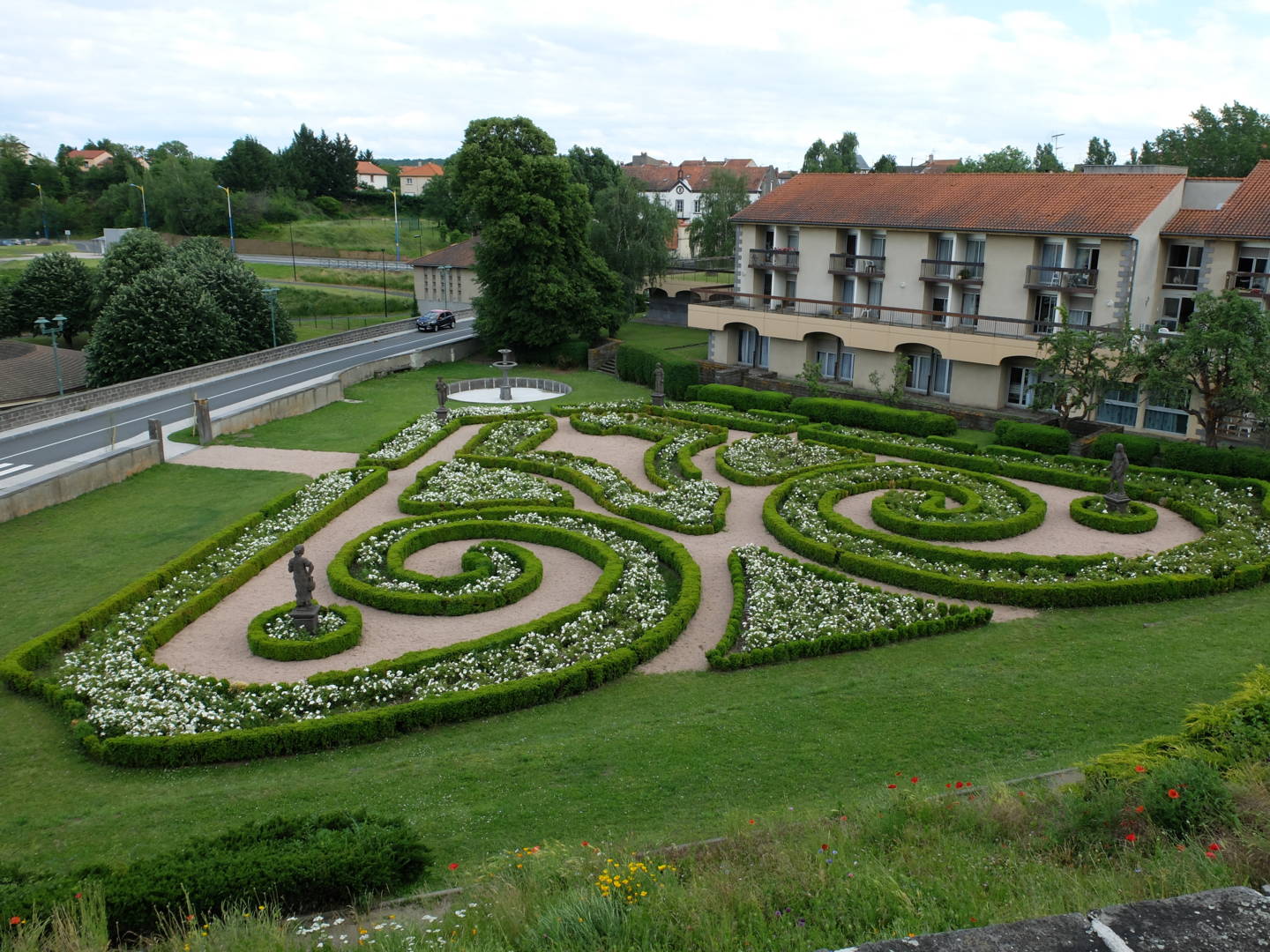
Two superb Italianate terraces dominate the garden. Seigneur de Bosredon wanted a garden to match his name.
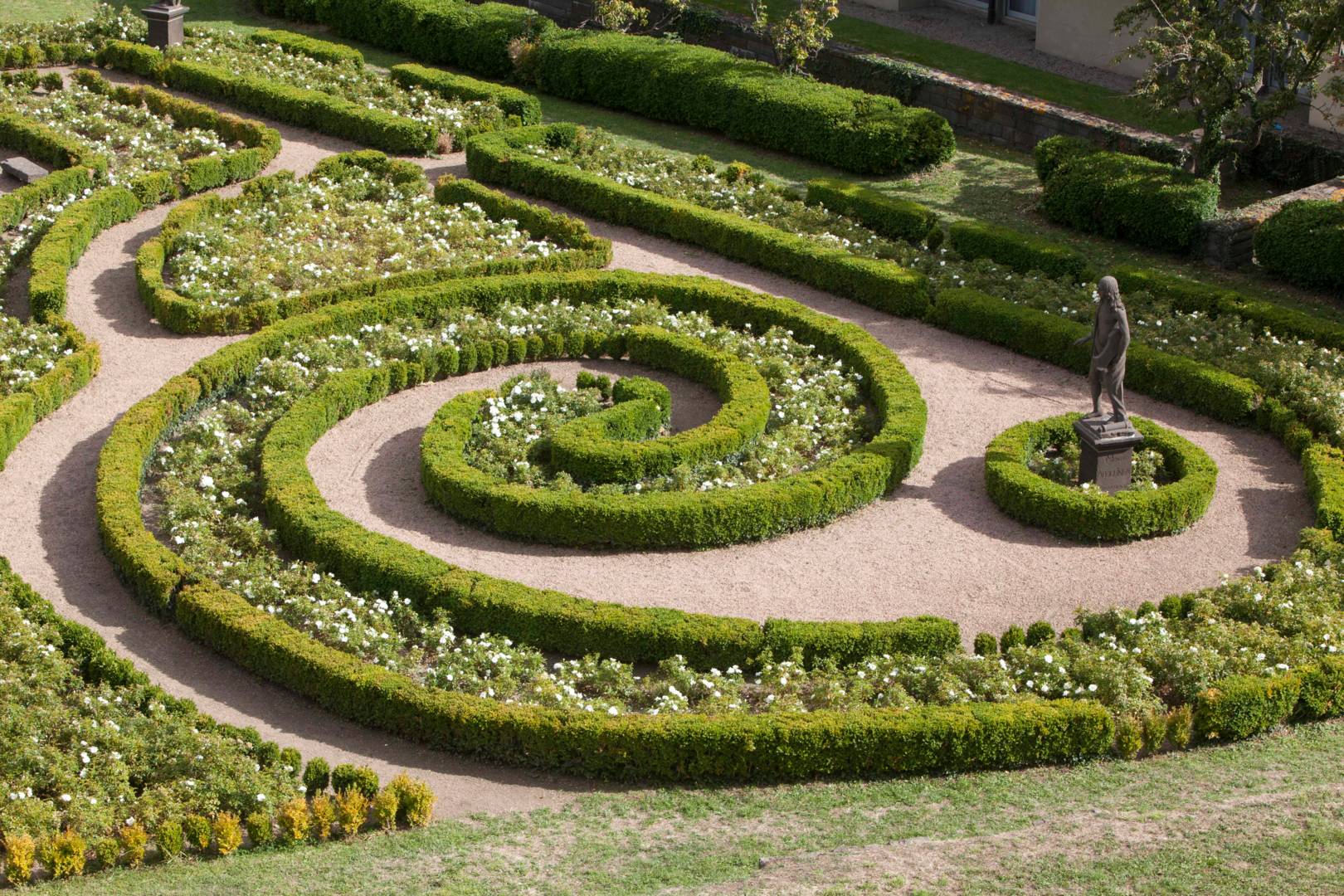
According to regional archives, the design was attributed to one of Lenôtre’s pupils, with parterres made of boxwood benches representing an upside-down fleur-de-lis.
This space is embellished by 4 magnificent 19th-century Volvic stone statues created by a local sculptor. Listed on October 20, 1971 by the DRAC as one of Auvergne’s 72 protected gardens. The estate was listed as a Historic Monument by decree on March 9, 2021. Today, it has been restored to its 18th-century splendor and its original layout.
Apollo, recognizable by his lyre or phorminx. This god is one of the principal Greek divinities. God of light, the arts, divination and healing (especially music and poetry), he tries to bring happiness to mankind through music, and is draped in a toga.
Three Muses, originally four, are easily identifiable by their names engraved on the base and by their attributes. They are the source of happiness and wisdom :
– Melpomène : muse of song and musical harmony, then of poetry. Known as the singer
– Euterpe : muse of music, she delights and charms humans, crowned with flowers and playing the flute.
– Thalis : muse of pastoral poetry, then of comedy, her attribute a bugle.
– Cerés or Déméter : (missing) Goddess of the Earth, fertility and harvest.
At the far end of the garden, a garden fountain with 2 basins, restored in 2013, and a linden tree several hundred years old complete this garden.
Another sculpture in this garden is hidden in an artificial pozzolana grotto in the alleyway of the former orangery.
A reclining Neptune, his right hand rests on a dolphin that spits water into the pool, and in his left hand, it is assumed, he must have been holding a trident.
This magnificent garden, with its box-tree embroidery, is a place for strolling and serenity for Volvic residents and tourists alike.
Source “Les plus beaux jardins d’Auvergne” Marie-Claire RICARD and Caroline DRILLON, Editions Sud-Ouest.

 Dogs allowed : On a leash
 Updated on 27 January 2022 by Office de Tourisme Terra Volcana, les Pays de Volvic