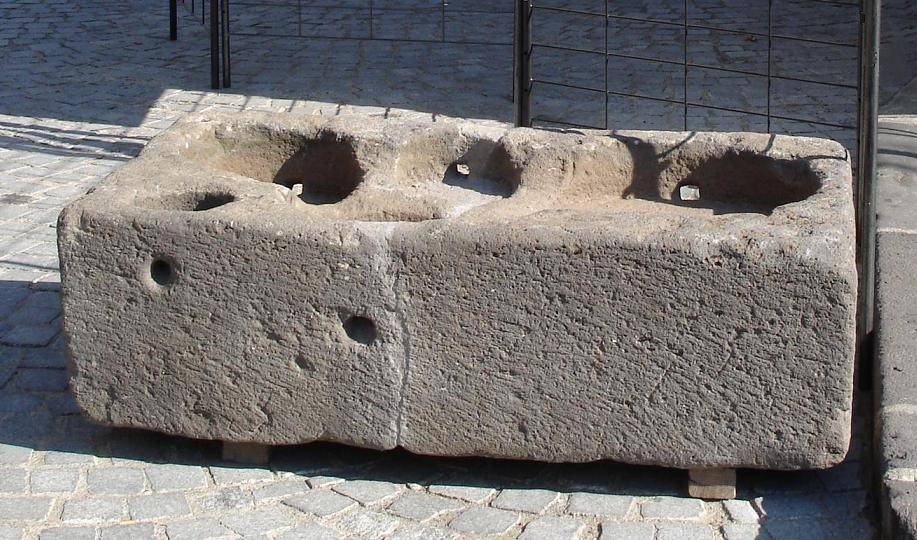
The tithe is a tax in kind, the tenth part of the harvest. It is due to the clergy to meet their needs, and is divided as follows :
– 1/3 for church maintenance
– 1/3 for the parish priest
– 1/3 for the poor
Borrowed from biblical customs, it(…)
The tithe is a tax in kind, the tenth part of the harvest. It is due to the clergy to meet their needs, and is divided as follows :
– 1/3 for church maintenance
– 1/3 for the parish priest
– 1/3 for the poor
Borrowed from biblical customs, it became compulsory in the 8th century, and was generalized under Charlemagne. It was often levied by monasteries, but also by laymen (following usurpation or inféodation).
This tax disappeared during the French Revolution.
This stone is a standard used to check the capacity of measuring devices, which varied from parish to parish. It comprises five loans with capacities of approximately : 0.75 liters – 1.75 liters – 2.30 liters – 17.50 liters – 56.75 liters ; the metric system did not appear until after the Revolution.
Few tithe stones have survived to the present day. The one at Châtel-Guyon appears to date from the 15th century. Another exists at Chirat in the commune of Teilhède. The Châtel-Guyon tithe stone has often been moved over the ages. At the end of the 19th century – beginning of the 20th, it can be found at the right-hand corner of the Église Sainte Anne, on the Rue de l’Ormeau side.
It can also be found in Docteur Aine’s garden, rue d’Angleterre. A few years later, at the request of the Town Hall, it was returned and placed in the tennis park, avenue Général De Gaulle, where it was used as a planter, whitewashed.
It has been carefully restored by the Courtadon company from Tourtoule in Volvic.