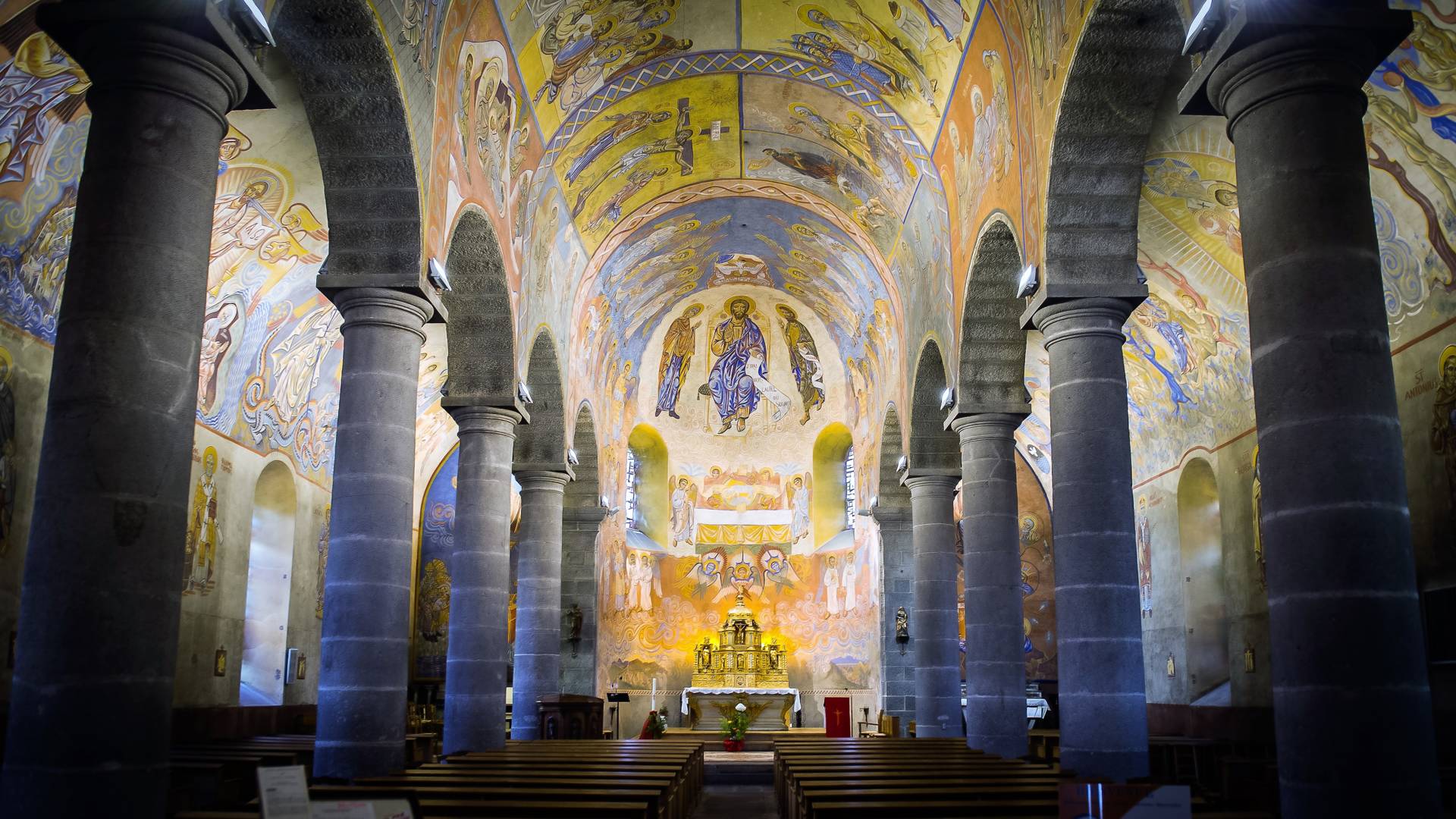
These are 900 m² of Byzantine-inspired frescoes, created without a model or written project in just 60 days during a particularly harsh winter, illustrating scenes from the Old and New Testaments. The lower right-hand side depicts Creation, while the lower left-hand side depicts the Apocalypse. In his work, Nicolas Grechny blended biblical characters with the background of the inhabitants of Châtel-Guyon representing mortals, sometimes with a touch of mischief.
THE GLASS
Designed by master glassmaker Yoki of Freiburg, they were made in 15 mm thick Baccarat crystal by Maison Benoît of Nancy in 1958.
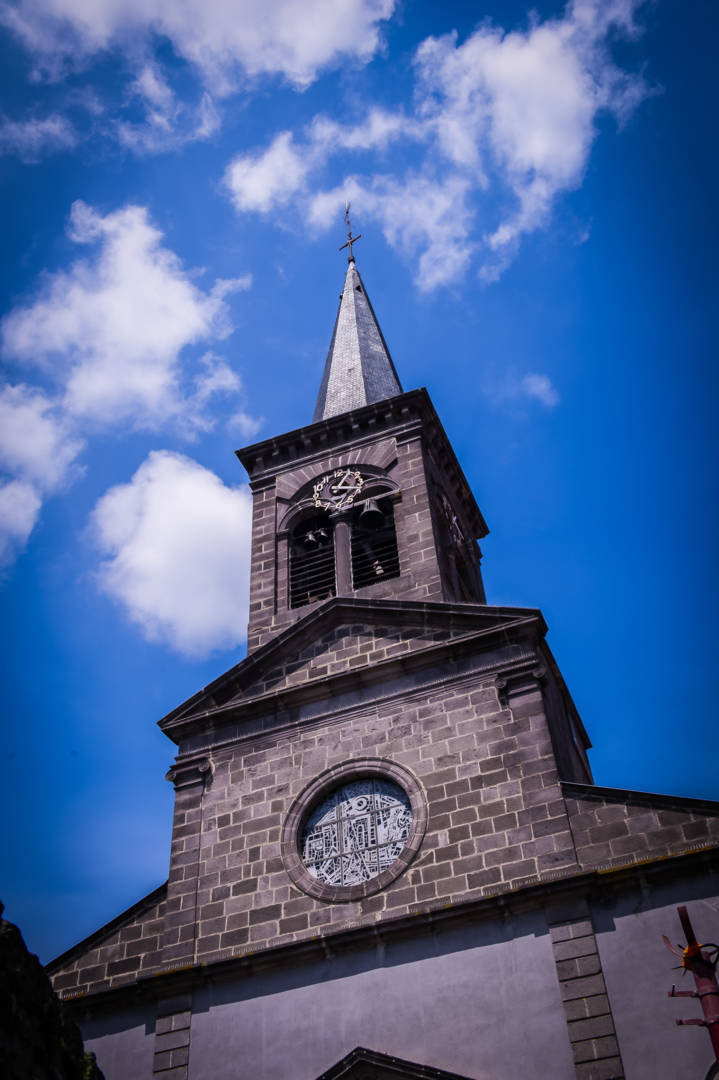
Only the “oculus” on the façade is figurative.
Inspired by the litanies, it sings of the glory of the Blessed Virgin : crowned with stars, Queen of Angels, House of Gold, honorable vase, church boat with the Cross as its mast, fisherman’s net, Seat of Wisdom, Gate of Heaven, Mirror of Justice, Mystical Rose, Lily among the thorns, Ivory Tower, The Holy Spirit who will cover her with his shadow, As beautiful as the moon.
FURNITURE
The church contains a number of items, some of which are listed : an 18th-century crucifix, a 17th-century altarpiece and a 15th-century Pietà.
THE ARTIST : Nicolaï Greschny (1912-1985) – A life of outlaw and fugitive
He was born on September 2, 1912 in Tallin, the capital of Estonia, into a family of “icon and fresco painters”. One of his ancestors painted the frescoes in Smolensk Cathedral.
This Russian family belonged to the Uniate Church, a breakaway from the Orthodox Church, which joined the Catholic Church while retaining its own liturgy.
The Russian Revolution of October 1917 forced the family into exile in Germany, where Nicolaï, after solid classical studies with the Jesuits, studied Fine Arts in Berlin (1932-1936).
Denounced for his Nazi resistance activities, he was forced to flee to Austria, where he studied theology. He then fled to several countries before arriving in Toulouse in 1940, where he continued his studies and joined a resistance movement as a nurse.
This experience, coupled with his profound faith, gave him exceptional cultural, theological and artistic stature.
At liberation, Nicolaï Greschny was alone, in exile. His homeland had become the Soviet Republic. He settled in the Tarn region of France, set up an iconography workshop and decorated several churches with frescoes.
In 1956, Canon Puyau, the parish priest, entrusted him with the decoration of Sainte-Anne church. He achieved the artistic and technical feat of frescoing the entire 900 m² of the church’s vaults, without a model or written plan, during one of the coldest winters of the century !
Greschny considered these frescoes to be among his most successful, as he was able to express himself fully in them without any constraints.
His work is immense : frescoes in over 100 churches and chapels, numerous icons, chasubles…
He died in 1985, and is buried in the crypt of the chapel he built at La Maurinité (Tarn), beneath a magnificent Christ, awaiting the resurrection evoked by one of his frescoes.
An association perpetuates his memory : Les Amis de Nicolaï Greschny, La Maurinité, Marsal.

 Updated on 9 August 2025 by Office de Tourisme Terra Volcana, les Pays de Volvic