On her death, a resident of Volvic donated a certain sum of money to the parish so that a monument could be erected in honor of the Virgin.
The idea of creating a monumental statue of the Virgin was born.
At the time, the director of the École d’Architecture de Volvic, Brother Gamaleil, wanted his students to create an exceptional work of art to enhance the image of his establishment (founded in 1820 by the Comte de Chabrol, Seigneur de Tournoël). The school took charge of creating the statue.
The sculpture was installed as close as possible to the sky, to keep a protective eye on the town.
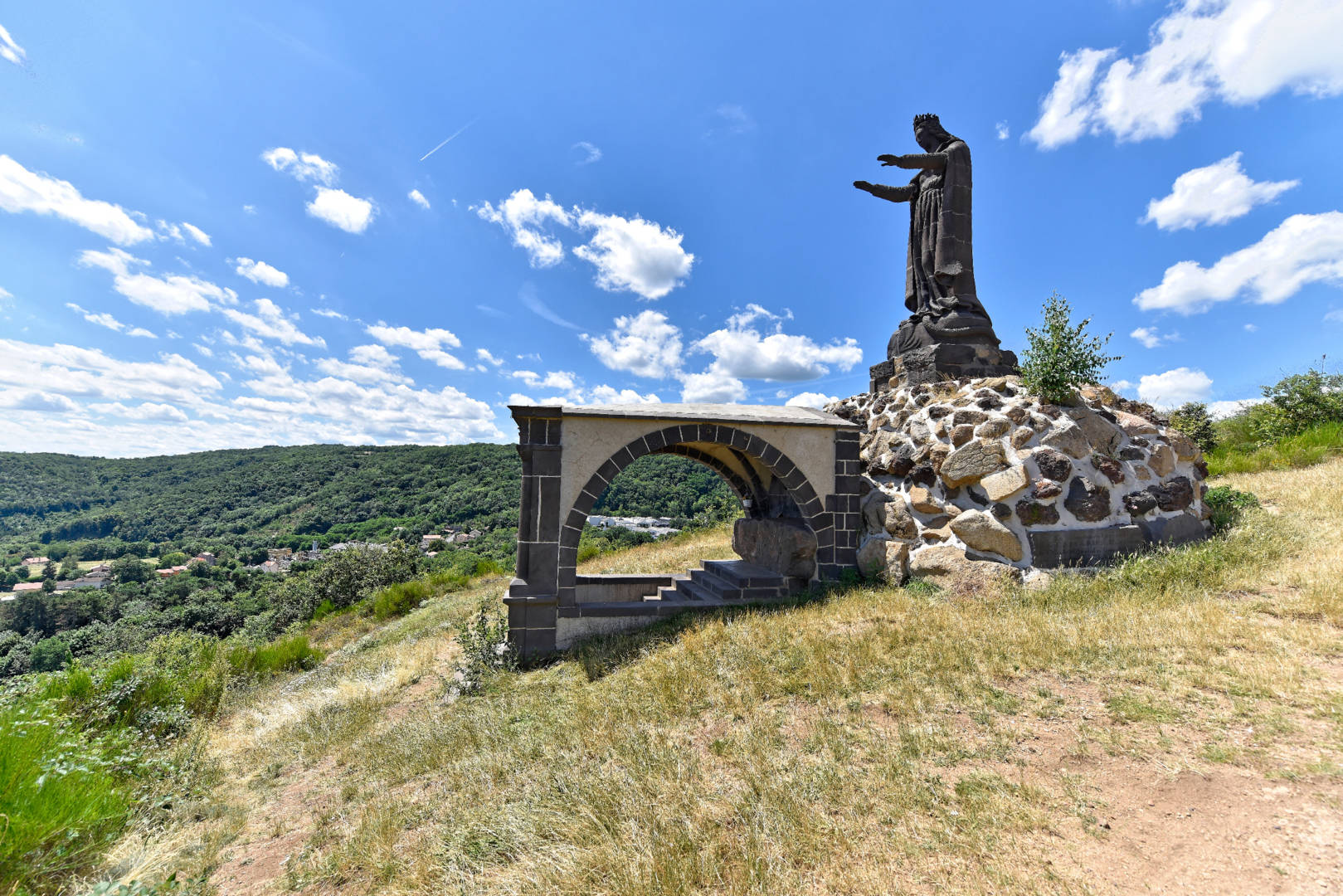
Made of Volvic stone, the statue’s arms are outstretched to face the village, as a sign of protection. She wears a starry crown on her head ; at her feet, she crushes the serpent, symbol of temptation.
This sculpture is made of several drums (the name given to the elements that make up the shaft of a column or statue) for ease of transport and creation.
The statue is 5.50 meters high, and the overall height is 9.56 meters.
At the time, the altar was very simple. A special fardier pulled by a dozen oxen transported the 13-ton block of porchyre (magmatic rock with large feldspar crystals) from “le bout du monde” (Enval commune) to the construction site.
The inscription on the block reads “Pour honorer Marie, ainsi que tout le monde, je vins péniblement ici du bout du Monde”. This inscription testifies to the toil the workers had to endure to transport this block of stone.
The rustic pedestal is made up of heaped rocks, between which are 4 slabs of Volvic stone engraved with quotations. Here is the inscription written by curé Berger :
“If you are impious, still hope ;
If you are a sinner, pray to her and you will be forgiven ;
If you are afflicted, pray to her you will be filled ; Mary my good mother, I entrust to you the care of my sheep”.
and 2 commemorative plaques (100th and 150th anniversaries).
On July 21, 1861, a mass was celebrated at Saint Priest church by the parish priest. Monsignor Louis-Charles Ferron was present at the ceremony, which took place at the summit of the Bannière. 6,000 faithful attended the inauguration. Since then, the Notre Dame de la Garde pilgrimage has taken place on the last Sunday in May, attracting large numbers of pilgrims.
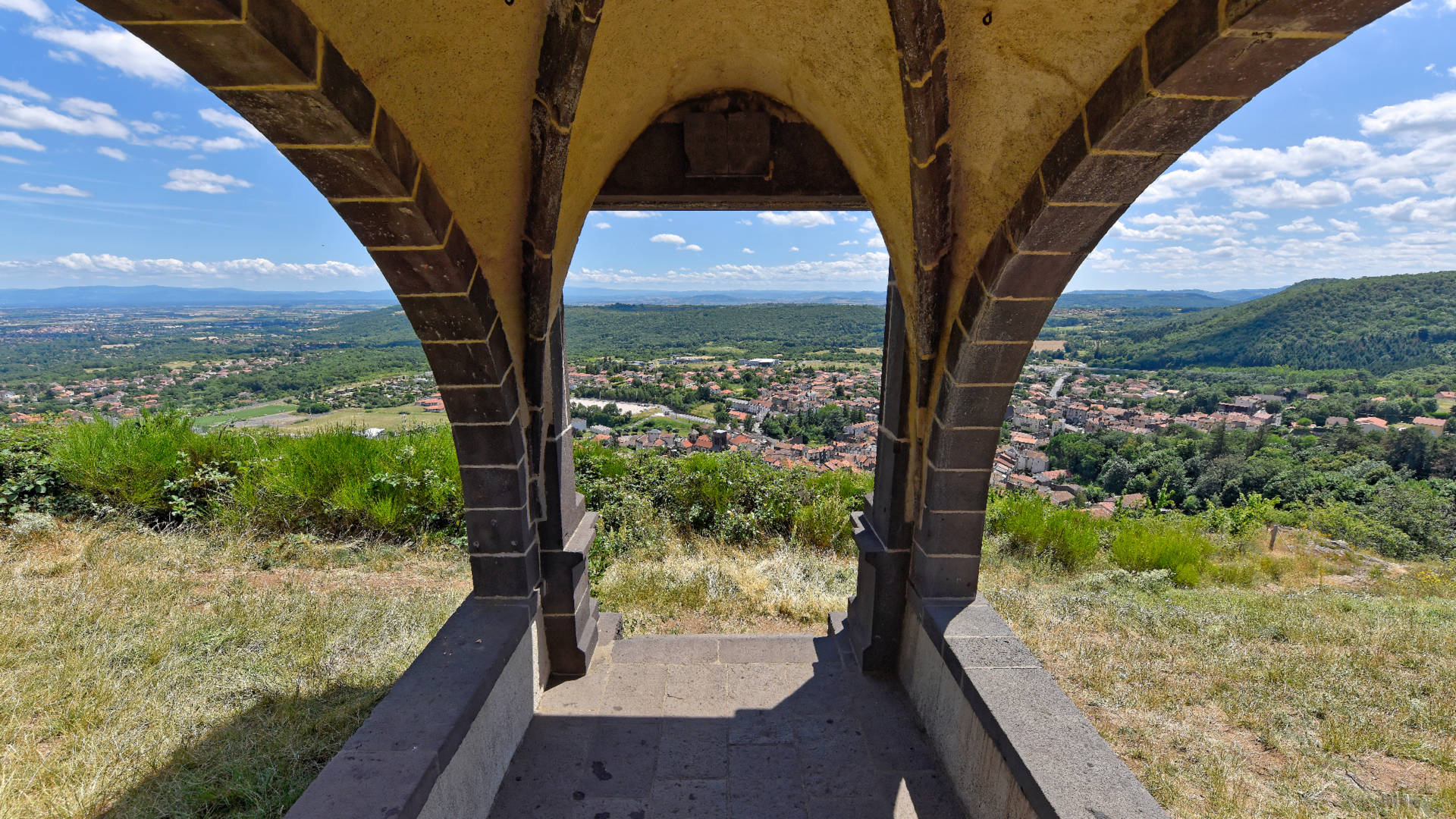
In 1869, arcades from a Gothic chapel (adjacent to the now-destroyed 12th-century church of Saint Priest) were reused to house the altar. The keystone depicts the coat-of-arms of the chapel’s founding family, the Delespins, seigneur du Vivet et de la Garenne, who lived in the 16th century.
The Way of the Cross leading to Notre Dame de la Garde
This calvary (a monument composed of one or two crosses, that of Jesus and the thieves crucified with him. The first calvaries appeared in the Middle Ages) was created in 1911 to replace the old one, which was too damaged. The crosses of the 14 stations were blessed and set in stone when the path was inaugurated. The first station is in rue de la Bannière.
On this circuit, you can discover “La Grotte du Soldat”. During the Napoleonic conquests, Volvic deserters from the great army hid here, hence the name. Inside, you can admire a statue of the Sleeping Christ, made of Volvic stone.
The Saint Priest church features a stained-glass window in the south transept arm, painted between 1872 and 1875, depicting Notre Dame de la Garde.
A replica of the statue is carried in procession to the top of the Bannière every May. Volvic’s Portuguese community accompanies this procession with Our Lady of Fatima, located in the third chapel on the right as you enter the church.
Stone-cutting techniques improved during the 13th century. This made it possible to work with hard stones such as Volvic stone. In the 19th century, many monuments to the Virgin Mary were built on the highest points of Auvergne towns and villages. There are many Vierges Noires (Black Virgins), painted and carved from cedar or olive wood, and presented as virgins in majesty. There are several explanations for this tradition : it recalls the ancient cults of the Celtic deities of stone and water, or a phrase from the Song of Songs : “I am black but I am beautiful, daughter of Jerusalem”) in Auvergne, but despite the color of its stone, Notre Dame de la Garde is not part of this heritage.
Research and writing : Association Volvic Histoire et Patrimoine
Close to GR footpath, In the country, Town outskirts, Isolated, Bus stop < 500 m, Close to a public transportation

 Updated on 17 March 2022 by Office de Tourisme Terra Volcana, les Pays de Volvic